

Creating Green Roofs: Design, Biodiversity & Best Practice
Green Roofs, Biodiversity Net Gain & the Future of Ecological Design in Cambridge
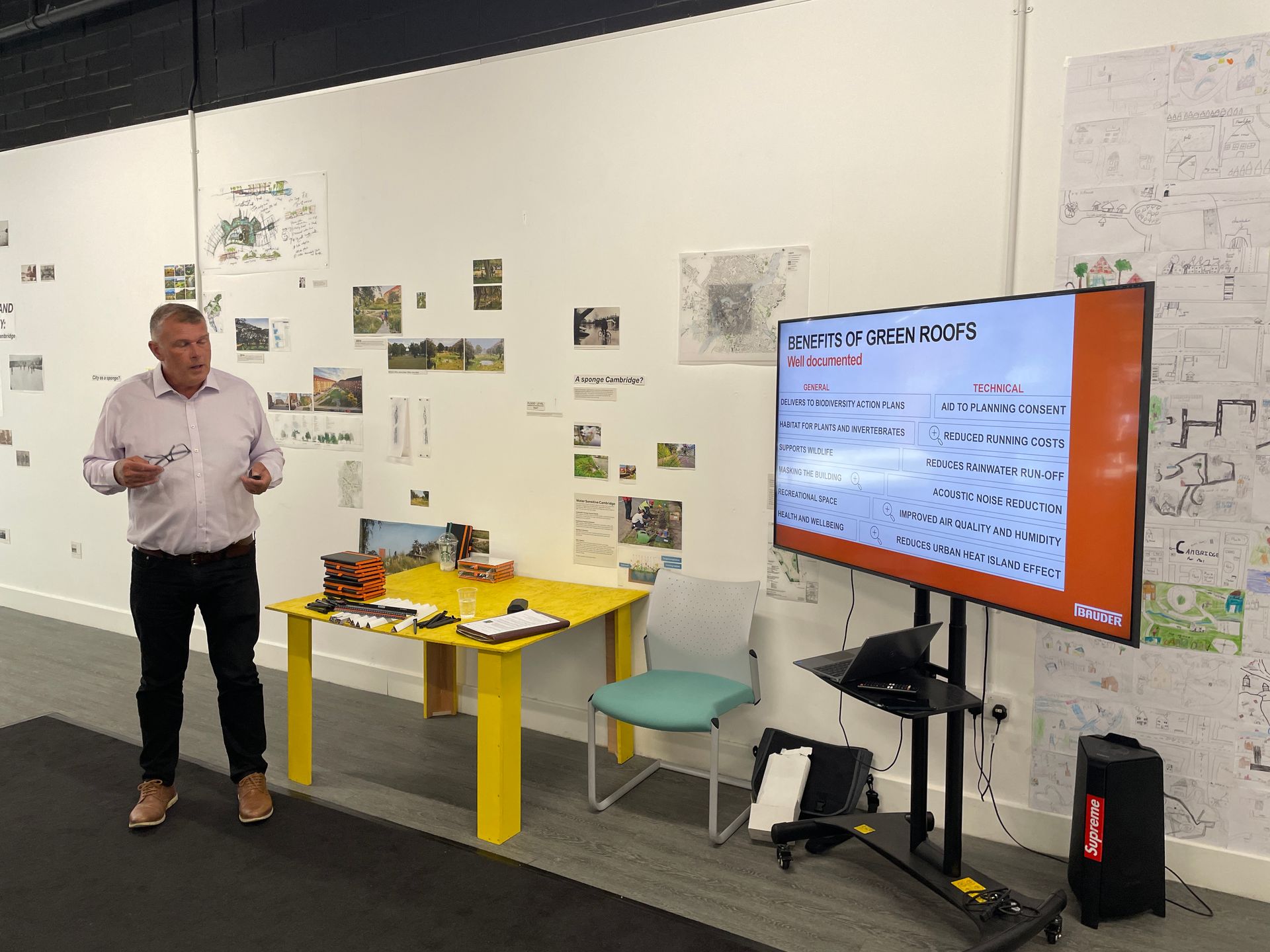
A review of the evening | Daniel Lee, Teasels Biodiverse Design Consultancy
A modest gathering from the Cambridge architecture scene came together recently for a CPD evening on green roofing, hosted by Bauder. Not a sell-out crowd, it has to be said, but a genuinely engaged one. I attended as someone who spends most of his working life thinking about cambridge native biodiversity and cambridge sustainable garden design, and I left with plenty to think about.
The session was delivered by Andre Jarvis and Hayden Davies, Bauder's local representative for Cambridgeshire. Between them they bring more than two decades at the company, and it showed: both presenters know the product inside out, and their presentation style was clear, confident, and anything but scripted.
Rather than working through a fixed script, they opened the floor early, inviting questions throughout rather than saving them for the end. It was a decision that set the tone for what became a genuinely interactive evening. The audience, a mix of professionals with a clear day-to-day interest in green roof specification, took them up on the offer repeatedly, and the resulting back-and-forth gave the evening far more depth than a straight lecture would have managed.
Discussion points such as pebble margins, fire breaks, and substrate depth were covered at length, alongside a useful overview of how the green roof industry has responded to post-Grenfell regulation. This is an area where the regulatory landscape has shifted considerably, and it was good to hear it addressed directly rather than skirted around.
Why green roofs are no longer optional
The substance of the talk centred on why green roofs have shifted from architectural indulgence to planning necessity. As many of you will know, Policy 31 of the Cambridge Local Plan requires any flat roof, including rear extensions, to incorporate a green or brown biodiverse roof to support local ecology and improve sustainable drainage. For those of us working in cambridge garden biodiversity planning, this has been one of the more welcome shifts in local policy in recent years.
Where a green roof was once something an architect specified on a personal project because they wanted one, the primary driver now is planning policy: specifically Biodiversity Net Gain and, more practically for smaller schemes, the Urban Greening Factor.
So: what is Biodiversity Net Gain? In short, BNG is a planning requirement that developments leave biodiversity in a measurably better state than before. It requires a baseline ecology survey of the site, a BNG assessment, and a commitment to achieve a minimum 10% uplift in biodiversity value. For a BNG application in Cambridge, that typically means working with an ecologist to produce a BNG condition assessment that can be submitted alongside the planning application.
The Urban Greening Factor takes a simpler approach: an area-and-depth calculation that several local authorities, Cambridge included, now favour for smaller schemes. The point was made candidly that BNG's requirement for a baseline ecology survey and a 10% uplift is often impractical at domestic scale, making the Urban Greening Factor the more workable option for many projects.
I wish there had been more time to explore the intersection between BNG and the Urban Greening Factor. It is a genuinely complex area and one that deserves its own session.
The sedum blanket problem
This is something I feel strongly about, so I will say it plainly. Designing a genuinely biodiverse green roof is, all too often, an afterthought. Architects, perhaps due to cost or simply a lack of knowledge, far too often default to a sedum blanket. Yes, sedum provides year-round colour. But it does very little for wildlife. As someone whose practice is built around gardening for wildlife in Cambridge and the surrounding area, I find this frustrating. As designers and specifiers, we can and should do better, and this CPD was a useful reminder of that.
It was noted that Cambridge specifically caps sedum content at around 30% to avoid monoculture and encourage genuine biodiversity. Good. That cap should be used as a floor, not a ceiling.
The case for green roofs
As the evening progressed, we were reminded of the multiple benefits of the green roof beyond planning compliance. The case was made on several fronts: protection of the waterproofing membrane from UV degradation and thermal shock, reduced surface water runoff, improved air quality, lower ambient temperatures for adjacent photovoltaic panels (worth noting for any scheme combining PVs with a green roof), and mitigation of the urban heat island effect. That last point feels more relevant with each passing summer. Normally when discussing the urban heat island effect, we tend to apply it to London or another major city. It is now equally relevant to Cambridge.
A practical taxonomy
The taxonomy section was the most practically useful part of the evening for anyone specifying rather than just appreciating green roofs. The now-expanded categories were run through clearly: extensive roofs, lightweight and low-maintenance (the important distinction between "low" and "no" maintenance was made carefully), typically sedum-based, with build-ups ranging from a 40mm blanket system up to 100mm substrate depths, the latter offering meaningfully better water retention and root development.
We didn't have time to go further into plant provenance and finer specification, which is a shame. There is much more to be said about how seeding green roofs with wildflowers, with proportionate post-seeding maintenance and watering, will make your green roof far more resilient to our changing climate in the medium to long term.
Biodiverse roofs, the successor to what used to be loosely termed "brown roofs", came in for particular attention. Do any architects remember the days of brown roofs, and what were your experiences? Lots of self-sown buddleia and little water-holding capacity. The category's murky origins were addressed honestly: there was an era when developers would dump inert waste and a bag of seed on a roof to tick a box.
Today's biodiverse roofs are a different proposition entirely. They are far more prescriptive, specifying plant species lists and habitat features such as dune ponds, log piles, and bee hotels. In effect, they are cambridge habitat creation services at height: carefully considered cambridge meadow habitat designs transplanted onto the roofline. These are the roofs most likely to deliver meaningfully against BNG or Urban Greening Factor targets.
From there the talk moved through semi-intensive and fully intensive roofs: accessible, amenity-focused builds combining hard and soft landscaping, capable of supporting trees, lawns, and street furniture, but with substrate weights climbing from around 43kg for a dry sedum blanket up to several hundred kilos per square metre once soil depth and water storage are factored in.
Irrigation
Irrigation prompted one of the evening's better exchanges. There is genuine debate about watering green roofs, and the divide is understandable. Ecologically speaking, the natural growth and senescence of plants has its own validity. But a green roof should also be delivering pollinator services, flood mitigation, and localised cooling. If we are producing green roofs that are burnt to a crisp by late May, due to our increasingly hot summers, then we need to think about this differently. Sensible water use, considered at the design stage, seems to me the rational position.
Leaky-pipe systems for extensive roofs were described as a practical solution, needing only occasional manual activation rather than constant running, with a single saturation lasting two to three weeks. A question from the floor about whether green roof irrigation had been exempted from recent hosepipe bans led to a useful, if slightly unresolved, discussion: a fire-safety-related exemption had applied nationally, though one audience member noted they hadn't seen it explicitly referenced in Cambridge's own restrictions. A small but telling reminder that national guidance and local implementation don't always align neatly.
A word from us
Teasels Biodiverse Design Consultancy is a cambridge garden consultancy specialising in cambridge ecological garden design and design for wildlife. If you are an architect or developer looking for guidance on BNG assessment, BNG condition assessment, ecology survey requirements, or cambridge garden biodiversity planning, we would be happy to talk. Find us at teasels-design.co.uk
