

How to Drought-Proof Your Land and Reduce Wildfire Risk
We Don't Have a Water Problem — We Have a Water Storage Problem

Drought-Proofing Your Land: Why Water Storage Beats Watering
I'm writing this in mid-August 2026. Parts of the UK haven't had meaningful rain in over 50 days. Lawns are straw. Hedgerows look like it's October, not August. And yet six months ago we were wading through one of the wettest winters and springs on record. It rained, properly rained, most days for months, right through to Easter.
Doesn't that already feel like a distant memory?
The numbers back this up. This year's wildfires have already burned over 21,000 hectares across the UK, and that's on top of a 2025 season that was, at the time, the worst on record. Yet by late May, barely a month after the wettest spring in years, water companies were already declaring hosepipe bans.
This isn't a blog about bashing the water companies, easy as that might be.
That contradiction is the whole story. We don't have a water problem in this country. We have a water storage problem.
The Land Remembers: How Land Management Shapes Wildfire Risk
If you want to understand this summer's wildfires, don't start with the weather. Start with what's been done to the land over the last few hundred years.
This may be a hard concept to grasp, but what we see in the landscape today isn't natural. It's a cultural landscape. It's an agricultural landscape — land that's been shaped over centuries by multiple, often political, factors.
Take a map of where the wildfires have been burning in the north of England this year, and lay it over a map of the moorland that's been drained for grouse shooting. They match. Not roughly — closely. Look towards continental Europe and you'll see the same pattern in a different guise: the worst fires are concentrated in commercial forestry plantations, not in biodiverse, structurally messy woodland. Monocultures burn. Diverse, wet, complicated land doesn't burn nearly as easily.
There's a reason the match is so close. Centuries of drainage — dug to replace living bog with the heather and grasses that sheep and grouse can feed on — have left our once-vast blanket bogs desiccated, dominated by a monotony of flammable heather and purple moor-grass.
None of this is new damage. It's old damage, showing up now at landscape scale. Generations of land management decisions since — drain it, simplify it, dry it out, make it productive — are coming home to roost.
Why We're Drier Than We Should Be
Here's the part that gets missed: we've disconnected ourselves from the water cycle. Rain that lands on our roofs and gardens gets funnelled into a downpipe, into a drain, into a sewer, into a river, into the sea, as fast as engineering can manage it. It's as if we're allergic to water — we've built an entire infrastructure whose only job is to get it off the land and away from us as quickly as possible.
It's not just roofs and gutters, either. Across most of our farmed land, field drains, ditches and artificially straightened streams and rivers are doing exactly the same job at a much bigger scale, sending rainfall barrelling toward the sea.
That's the opposite of what we need right now. We need to slow water down — slow the flow — not just so it puddles on the surface, but so it has time to soak in, recharge the soil, and refill the aquifers underneath us. Every garden, every rewilded paddock, every scrap of land that water passes over has a part to play in that.
Source Control and Sustainable Drainage (SuDS)
There's a name for this in the sustainable drainage world: source control. It's one of the core principles in the CIRIA SuDS Manual — keep water on your land for as long as possible before you let it go anywhere else. It's never mattered more than it does right now. It's a long document, but well worth a read.
Slow the Flow: Drought-Proofing Tips for Any Garden
A community group in the north of England coined a phrase for this a few years back: Slow the Flow. It's a good one to borrow, because it's exactly the right instruction for a garden of any size.
Start small. Disconnect your downpipe from the drain and send it into a bed, a lawn, the soil — anywhere that isn't a pipe heading straight to the sewer. Next time you're out on a dog walk, look at the drainage ditches running alongside the footpaths. Now imagine them blocked, or at least slowed with a few well-placed obstructions, instead of doing their job of shipping water off the land as efficiently as possible.
Yes, that means some "flooding" — but flooding is perfectly natural. Land floods. What we've done is disconnect ourselves from that flood cycle: by straightening rivers, we've cut them off from their floodplains.
On a smaller, more personal scale: try seeing the boggy corner of your garden or field differently, rather than as a problem to be fixed. It isn't. It's the landscape telling you exactly where the water wants to be. Lean into it, don't drain it.
For Bigger Land: Paddocks, Fields and Whole Sites
If you've got more than a domestic garden to work with, there's more you can do.
Ponds, Scrapes and Natural Flood Management
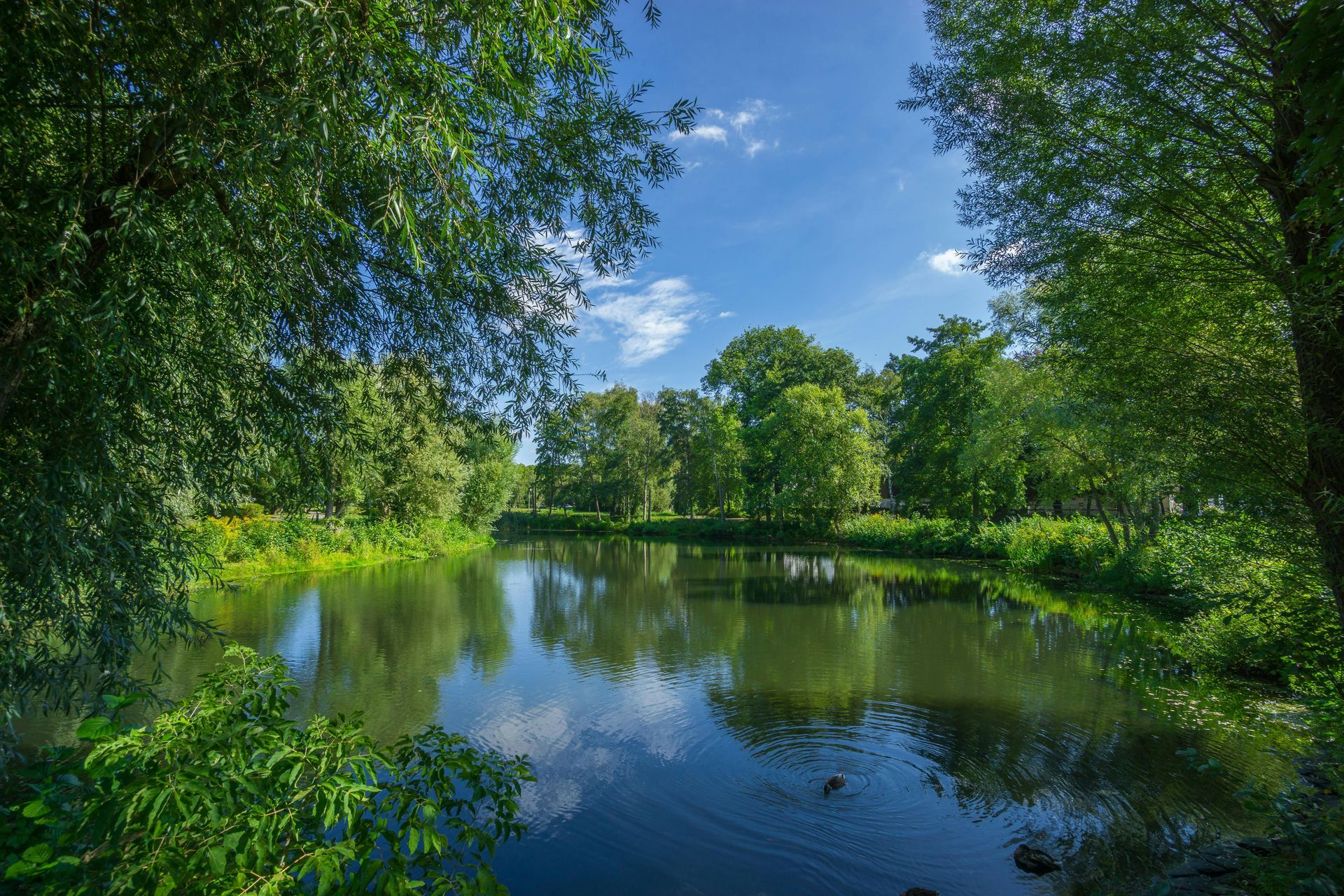
Let unproductive fields flood. If your land has been simplified over generations — flattened, drained, tidied into uniform, species-poor grassland — now is the moment to reintroduce some chaos. Dig scrapes so water has somewhere to sit and soak in over days rather than minutes. Put in a pond, even a small one; it's standard ecological advice for a reason, and the impact is always bigger than the size of the pond suggests.
Beavers and Natural Wildfire Firebreaks
If you've got a stream or watercourse running through your land, look at what beavers do with exactly this problem. Where they've been reintroduced, they build strings of dams that raise the water table across whole valley floors — a chain of ponds, scrapes and slowed, re-wiggled streams that acts as a landscape-scale firebreak, while creating habitat for amphibians, dragonflies and water birds along the way. You don't need beavers on site to borrow the principle: re-wiggling a straightened stream, or building a few leaky, timber-and-brash dams by hand, does much the same job at a smaller scale.
Embody your inner beaver!
If you're managing meadows or rough grassland, think about taking an early cut to remove dry biomass — it's one less thing to burn later in the season. And depending on the scale of your land, fire breaks or gravel strips are worth considering too, though they're a smaller part of the picture than water is.
Rewilding Isn't the Villain Here
There's been a lot of noise this summer blaming rewilding for the fires — fewer sheep, more scrub, more fuel building up unchecked. Sheep farming representatives, grouse shooting interests and a chorus of anti-rewilding commentators have all reached for the same story. It doesn't hold up, and the fire maps make that clear: look at where the fires have actually been burning, and it's drained grouse moor, commercial monoculture, tightly mown amenity grassland with nothing else going on — not rewilded land, and not land with large herbivores moving through it, grazing, trampling, dunging, doing the job they've always done of breaking up fuel before it can build into a problem.
Do you put sheep out on a paddock or field you're not sure what else to do with? You might be adding to the problem.
Sheep also strip out the deciduous scrub and tree saplings that would otherwise compete with heather, which locks the land into exactly the flammable monoculture we're now watching burn. Sheep remove that heterogeneity from the land. It's something we need to add back: more chaos, more scrub, more trees, more species-rich grassland — all of these habitat types interlocking into a mosaic.
None of this happens instantly — monoculture takes years to loosen its grip. But if your land is big enough to support grazing animals, permanently or seasonally, at low density and the right mix, that's one of the oldest and most effective fire-resilience tools there is. If your landholding is over a hectare, it's worth considering — not just as one of the best rewilding tools available, but for the added benefit of reducing wildfire risk too.
It Starts With the Soil: Soil Organic Matter and Water-Holding Capacity
Every part of this comes back to soil. Organic matter is what gives soil its capacity to hold water in the first place, and the effect is significant: Rothamsted Research has calculated that every 1% increase in soil organic carbon adds roughly 354,000 litres of water-holding capacity per hectare, to a depth of 30cm. Our soils, on the whole, are impoverished — organic matter levels are low across most of the UK's farmed and gardened land. Rebuilding that isn't a quick fix. It's a five, ten, twenty-year project, and the case for starting now rather than later gets stronger every summer.
The End of the Conventional Lawn
I'll say something that won't be popular with everyone: the era of the conventional lawn is over. I've thought carefully about including this line — it's not there for clickbait, and I'm not saying it to shock.
Feeding it, watering it, spraying it, mowing it into a uniform green carpet — properly maintaining a lawn like that, especially in the South East, is hard to defend right now.
The alternative isn't a dead garden. It's a meadow, or for many gardens, something more practical: a clover or legume lawn, mixing in white clover, red clover, black medic, plantain. It stays green considerably longer into a drought than turf grass does. I won't oversell it — in a genuine four or five month drought, even a clover lawn will go brown and wait for rain like everything else. But it buys you weeks, sometimes months, that ordinary turf simply doesn't have.
Reading Your Plants: Early Leaf Drop and Drought Stress
If your trees and shrubs are dropping leaves early this year, that's not necessarily them dying. In a lot of cases it's early senescence — a deliberate, natural response to drought stress, shedding leaves to cut water loss before real damage sets in. Worth knowing before you assume the worst.
Planting for the Next Fifty Years
Native planting is still the best choice for wildlife, full stop. But it's worth finding a midground now: bringing in near-native and non-native species alongside the natives, specifically for their drought and heat tolerance. We're not planning for next year. We're planning for the next 50, and realistically we should have started 50 years ago. As the old line goes, the best time to plant a tree was 50 years ago — the next best time is now.
One more nuance worth having: deadwood matters. Birds need perches, territory, nesting sites, and a proportion of standing and fallen deadwood in any landscape is genuinely valuable. But whole stands of dead trees en masse isn't the same thing, and isn't the goal.
Structural Diversity Beats Monoculture, Every Time
If you take one thing from all of this: look at your land. If it's a monoculture — tight amenity grass, no scrub, no trees, no bramble, no hedging — it is simply more exposed to wildfire risk than land with a mosaic of habitats layered into it. That's not opinion, it's what the fire maps show, again and again, this summer and every summer like it.
Where We Come In: Site Surveys and Landscape Design
This is exactly why a proper site survey matters before any design work starts. At Teasels, that means a full topographical survey and a landscape-scale survey, using LiDAR and other mapping software, looking at how your site's water fits into the wider catchment around it — not just what's happening inside your boundary. Our preliminary ecological assessment goes further back than the plants currently growing on site: we look at how the land was used 50, 100 years ago, because that history is usually still shaping how water moves across it today. That "poorly drained" corner your garden has always had a problem with? Once you understand the site properly, it usually turns out to be an asset, not a fault. You can read more about how we approach this on our design process page.
I'm an Optimist
I think 2026 could be the tipping point. I hope it changes government policy — makes it easier to build reservoirs, easier to dig a pond in a paddock, easier to do the obvious, sensible thing with water instead of fighting bureaucracy to do it. I think we're heading, slowly, towards valuing structural diversity over monoculture, because the alternative keeps burning.
There's a live political fight happening right now over exactly that question — whether the answer to a burning summer is more control, or more wildness. I know which side of that argument the fire maps are on.
No water, no life. It's one of those lines that sounds obvious until you say it out loud, and then it sits with you.
The rain will return. It always does — we said the same thing in January, convinced it would never stop, and by August it had. The question isn't whether the drought ends. It's whether we've done the work to hold onto the water when it does.
Are you ready to hold it?
Quick Tips
- See water as a resource, not a nuisance
- Disconnect your downpipe — send it into a bed, lawn or the soil, not the drain
- Install a pond, however small
- If you have a watercourse on site, consider beavers — or borrow the principle with leaky, hand-built dams and a re-wiggled stream
- Stop treating the wet corner of your garden or field as a problem
- Get a topographical, landscape-scale site survey done
- Get a soil survey — know your soil type and organic matter percentage
- Convert lawn to meadow, or to a clover/legume mix
- Dig scrapes in paddocks or fields to hold water longer
- Take an early cut on meadows to remove dry biomass fuel
- If you graze animals, favour cattle or ponies at low density over sheep — sphagnum survives grazing, but not trampling
- Build soil organic matter — every 1% adds roughly 354,000 litres of water-holding capacity per hectare
- Prepare now. The rain always comes back.
Sources Referenced
- CIRIA SuDS Manual — resource hub via susdrain.org
- Rothamsted Research soil organic carbon / water-holding capacity figure, via NFU
- Ben Goldsmith, "Rewilding is the best defence against wildfire", Substack, 13 August 2026
- Wild Haweswater (RSPB / United Utilities)
- IUCN UK Peatland Programme
