

Habitat-Led Garden Design in Cambridge | A Nature-Friendly Approach
The Future of Landscape Architecture in Cambridge
Working With What We’ve Got: Towards Habitat-Led Garden Design
Having just read yet another post about rewilding , the now ever-present “R word”, and the important work being carried out at large landscape scales, it got me thinking about our role within this conversation as garden designers and landscape architects.
Because most of us are not working at that scale.
We are working in gardens, courtyards, verges, and fragmented pieces of green infrastructure. Smaller sites, yes — but collectively, incredibly significant.
So what does rewilding actually mean at this scale? And more importantly, how are we going about what we do?
Rewilding, at its core, is about restoring natural processes. But in a garden context, we are not stepping back entirely. We are still intervening, designing, and managing. So perhaps the real question is not whether we are “rewilding”, but whether we are working honestly with ecological processes.
And that begins with something deceptively simple: working with what we’ve already got. Strangely, this feels like a novel idea.
Much of the landscape and garden design industry is still driven by replacement — strip out, clear, import, install. Materials arrive on pallets. Planting schemes are delivered fully formed. The site becomes a blank canvas. But in that process, what are we losing?
Before we design anything, there is a more fundamental question that often goes unasked:
What habitats are already on site, and what condition are they in?
On small, non-BNG projects, how often do we properly assess this? A simple UKHab survey, or even a light-touch Preliminary Ecological Appraisal (PEA), would go a long way. Not as a planning requirement, but as a design tool.
Because without that baseline, we are operating on assumption.
And in doing so, we risk removing functioning , if imperfect , habitat. A hedge that acts as a wildlife corridor. A patch of nettles supporting invertebrates. A rough grass edge richer than it first appears.Too often, these are replaced with something more controlled, more legible, more “designed”.
We also need to start seeing opportunity where we currently see problems.A downpipe overflowing in heavy rain. Water pooling in a front garden.The instinct is to fix it, to install drainage, to resolve the issue. But what if that “problem” is actually the beginning of a seasonal wetland habitat?
By simply allowing water to move and collect, we can create ecological value without importing anything new.
This is a fundamental shift in mindset — away from solving problems with products, and towards understanding what existing conditions are already doing.
Take the classic “bad lawn”. Cut short, week after week. Clippings removed. Diversity suppressed over years, if not decades. The instinct is often to remove it entirely and start again. But that lawn is not empty , it is a suppressed system.By changing the management , reducing mowing, adjusting cut-and-collect regimes, and introducing additional species where appropriate , it can begin to transition towards a species-rich meadow, or at least form the foundation of one.Not instantly. But meaningfully.
This is where habitat-led garden design begins to emerge.Not design driven purely by aesthetics, but by ecology. By asking: what is here now? What condition is it in? What could be here? And importantly, what was here before?Because every site has a history — embedded in its soil, its hydrology, its seedbank. Understanding that history allows us to work with the site, rather than against it.
Of course, language matters. Terms like rewilding, sustainability, and naturalistic planting shape how we communicate our work.But they can also become diluted through overuse.What matters is not what we call it, but what we produce.
Are we creating real ecological function? Are we designing for complexity, for niches, for micro-niches? Are we consciously working with ecotones , those rich transitional zones where habitats meet? Because this is where biodiversity thrives. And if we are serious about biodiversity and ecological garden design, we need to go deeper.
Beyond pollinator planting. Beyond bee-friendly palettes. Important though these are, they represent only a fraction of ecological systems.
Where is the focus on soil health? On fungi, bacteria, and decomposers? On food webs and trophic relationships?
Where is the attention on the ant hills, the worm populations — the unseen systems that underpin everything?
Because this is where true ecological function sits.
As my friend and podcast guest Benny Hawke often discusses, if we are serious about designing for wildlife, we need to include elements that challenge conventional expectations. Bare ground. Sparse vegetation. Disturbance.
But who is actually doing that in residential garden design?
And are we prepared, as designers, to prioritise plants based on ecological interaction , what supports feeding, nesting, and breeding , rather than purely on aesthetic appeal?
Are we willing to leave out species that offer little ecological value?For a creative industry, that is not always an easy shift.
Take the ecotone between tussock grassland and early successional scrub. It is messy, dynamic, and constantly changing — and ecologically rich.
Yet in design, we often attempt to replicate this condition through controlled planting compositions. Ordered drifts. Managed structure. Predictable outcomes.
But the real ecotone is not a composition. It is an ongoing process.
To design for it requires letting go , allowing systems to emerge, rather than fixing them in place.Working in this way also challenges how we practice.
It becomes slower, more iterative, more collaborative. The role of the gardener becomes central. The design is no longer a finished product, but an evolving system.
Even fee structures may need to shift , from fixed deliverables to ongoing engagement. If this approach is repeated , project after project, it begins to normalise.
And if leading designers and practices embrace this way of working, the shift accelerates. Client expectations change. Industry standards evolve.Perhaps most importantly, we begin to reshape what is considered beautiful.
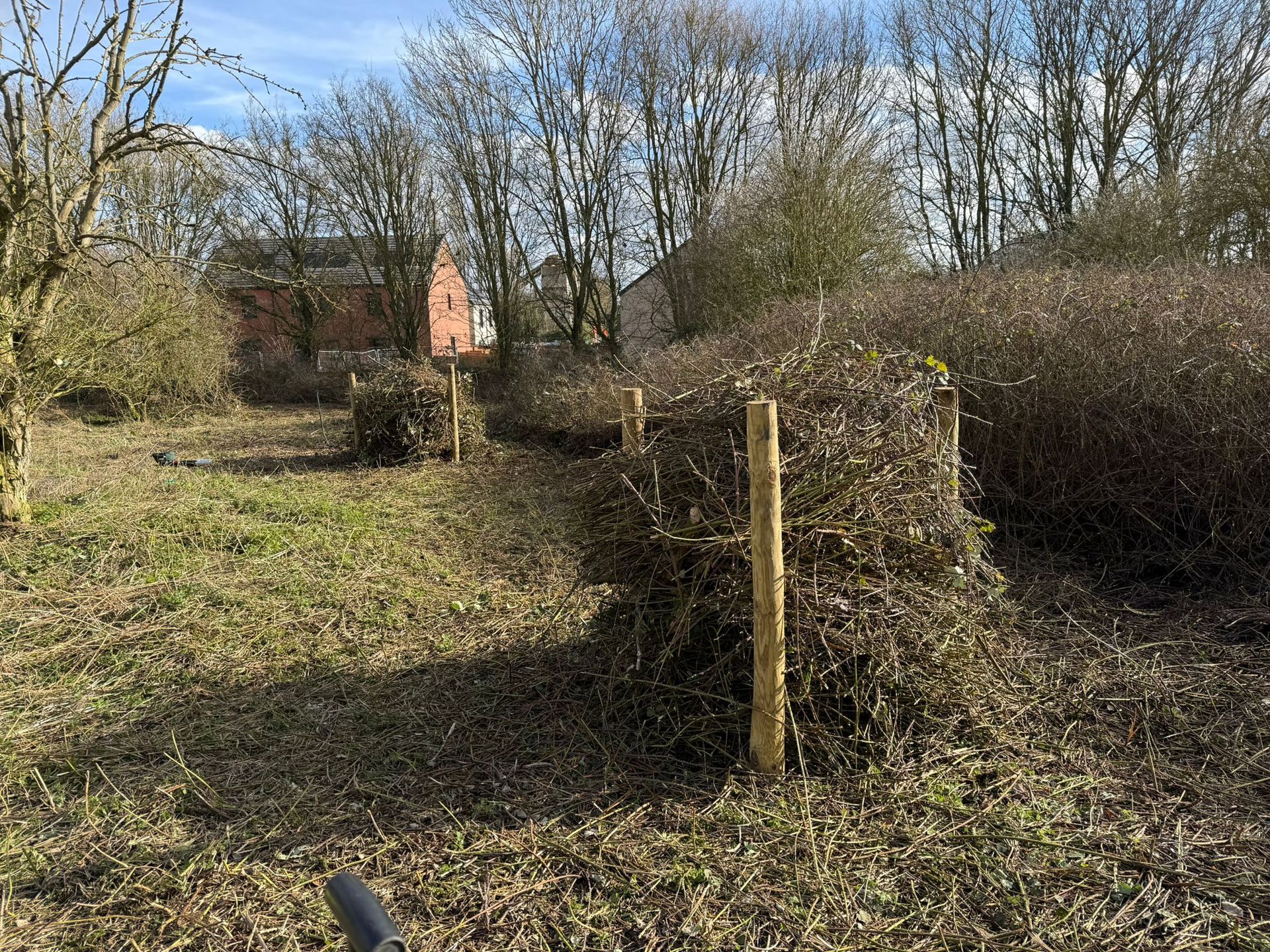
We design the “scruffy” spaces. We retain the bramble. We allow edges to blur and systems to develop.
And over time, people begin to see the value in these landscapes , not just aesthetically, but ecologically.
They begin to want them.
At its core, this is simple.
We need to give wildlife what it actually needs.Not a stylised version. Not an aesthetic interpretation. But real ecological function — supporting food webs, providing habitat, enabling breeding, and sustaining life.
This is not about abandoning design. It is about evolving it.
From creating landscapes…
to supporting living systems.
From imposing ideas…
to working with what is already there.
