

Your whole garden is a bird feeder !!!
How to Make Your Garden into a Bird Feeder?

The RSPB has advised against feeding birds from bird feeders during the summer months. The headlines have done what headlines do: sensationalise, simplify, divide. But beyond all of that, I want to focus on something more useful. On action. On living creatures, living systems, and what we can actually do to help.
First, I can 100% understand the appeal of bird feeders. The sight of birds gathering at one spot, visible from your window, is obviously appealing. And for a client who is immobile and can't get into their garden, a bird feeder is a genuine connection to the wildlife they once enjoyed. I don't dismiss that for a moment.
But how did we get here?
In short, man has radically changed the landscape that birds live in. Large parts of the UK are given over to agricultural land, which is a dead zone for wildlife in general, and especially for birds and the food webs on which they rely. Man has removed their food source. Bird feeders have, in many places, become one of the few spots where birds can actually find food. But this is unnatural, and not all birds will, or can, use them. Many species won't go near a feeder due to fear of predation. What feeders do favour are the species that are already more territorial and adaptable: pigeons, parakeets, blue tits, magpies.
So the RSPB announcement is, for me, a pivotal moment. Not a problem, but an opportunity. An opportunity to bring to people's attention what birds actually want and need, and to refocus on something far more powerful than a feeder.
Make your whole garden a bird feeder.
That is the reframe. And it starts with understanding what birds actually need at a biological level. This is where the concept of Invertebrate Habitat Potential becomes useful. It is a tool ecologists use to assess how well a given space can support invertebrate life, looking at things like structural diversity, bare ground, dead wood, south-facing aspects, water, and the breadth of native plants present. The higher the potential, the greater the bio-abundance at the base of the food web, and the greater the capacity of that space to support everything above it. When I look at a garden now, this is the lens I use. Not how it looks, but what it can hold.
So what does this mean practically? Here is where I want you to focus, and here is where I want to take the conversation somewhere most garden writing simply doesn't go.
Plant a native hedge, and understand why it works
Not a photinia Red Robin. Not a laurel. A mixed native hedge: hawthorn, blackthorn, field maple, hazel, dog rose, elder, spindle, buckthorn. The reason this matters is not aesthetic, it is evolutionary. These plants have co-evolved with our native invertebrates over thousands of years. Hawthorn alone supports over 300 species of insect. That is not a coincidence. It is the result of millennia of co-evolution, of insects learning to read, use, and depend on these specific plants. A laurel hedge, by contrast, is biologically silent.
When you plant that hedge, allow it to grow out at the base. Allow the buckthorn to sucker. Allow the grass at its foot to grow long. What you are creating is a layered system: the canopy of the hedge, the shrub layer within it, the tall grass at its base, and the leaf litter and thatch below that. Each layer is a distinct habitat. Each layer supports different species at different times of year. The long grass creates thermal mass at ground level, warmer than the surrounding garden, and that warmth is what our overwintering invertebrates rely on. It is also what ground-nesting birds such as the wren and the dunnock need: dense, undisturbed, warm cover.
And the interface between the long grass and the hedge base is itself a habitat. Ecologists call this the edge effect: the zone between two different habitat types is often the most biodiverse part of the whole system. Every time you create a boundary between two different structures in your garden, you are creating that edge. Think about that when you are making design decisions.
Allow bare ground, and understand its value
Bare ground is one of the most undervalued habitats in the British garden. When we look at it through the lens of Invertebrate Habitat Potential, bare ground, especially south-facing, undisturbed, and warm, scores extraordinarily highly. Our solitary bees, the mining bees and mason bees that are doing the real pollination work in our gardens, need bare soil to nest in. They need it warm, undisturbed, and accessible.
This is the ecological argument for self-binding gravel over non-permeable paving. Not just permeability, though that matters, but the fact that self-binding gravel creates an open, warm, textured surface that ground-nesting bees can actually use. When you are choosing hard landscape materials, this is the question I want you to ask: what is the Invertebrate Habitat Potential of this surface? Run that question across every material decision you make and watch how your choices change.
Create still air, and understand why butterflies need it
Butterflies are ectotherms. They cannot generate their own body heat. They rely entirely on external warmth: from the sun, from warm surfaces, from still air in sheltered spaces. Their mating dances, those spiralling flights you see on a warm afternoon, require specific microclimatic conditions. Warmth, stillness, and the right structural backdrop. When we design gardens as open, exposed spaces with clipped edges and hard surfaces, we remove those conditions entirely.
A dense hedge on the north and west boundary, a south-facing aspect, long grass and flowering plants in the middle distance: this is a butterfly garden. Not because it is labelled as one, but because it has recreated, at a small scale, the microclimatic conditions that butterflies evolved to use. This is what I mean by thinking at a system level.
Put in a pond, and think beyond your boundary
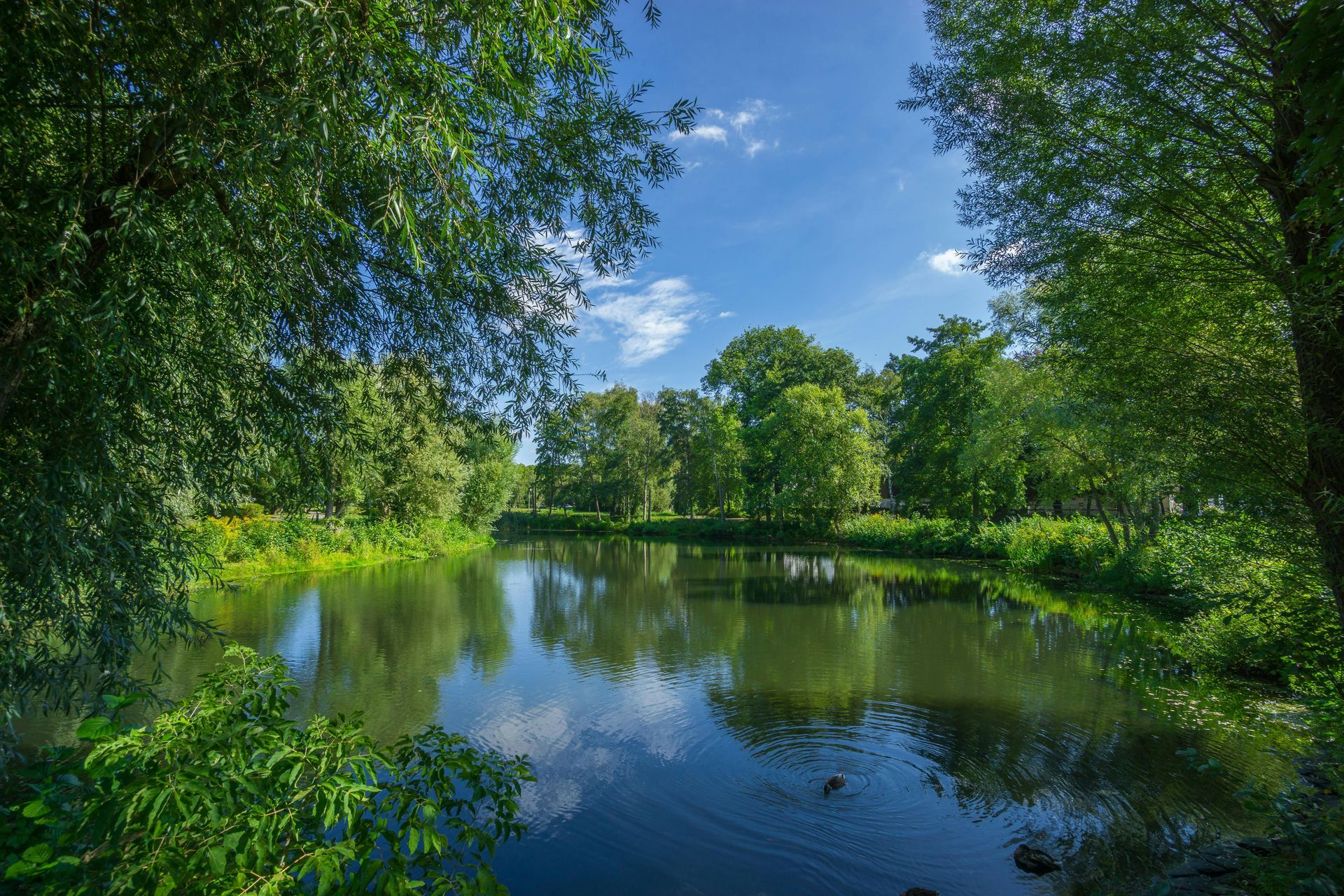
Any size. I mean that. A pond the size of a washing-up bowl still holds water, still supports invertebrates, still contributes to the food web. But I want you to think bigger than your own garden. If every garden in your street held a body of water, however small, and those gardens were connected by hedges and long grass and permeable surfaces, what we would have created at a landscape scale is a wetland corridor. We would have created connectivity. And connectivity is everything in ecology.
Isolated habitats fail. The reason so much of our wildlife is in decline is not simply that individual habitats are degraded, it is that they are fragmented. Species cannot move between them. Populations become isolated, vulnerable, unable to recover. When you put in a pond, and your neighbour plants a hedge, and the person two doors down lets their grass grow, you are collectively rebuilding that connectivity. Your garden is not a standalone space. It is one node in a network.
Understand bio-abundance, not just biodiversity
We talk a great deal about biodiversity, the number of species present. But the number that matters more is bio-abundance: the sheer mass of living organisms at each level of the food web. A garden can record fifty species of butterfly and still be ecologically empty if there are only two or three individuals of each. That is not a functioning food web. That is a list.
What our birds need is not variety. It is mass. It is the raw protein of millions of invertebrates, present in sufficient quantity to raise a brood, to survive a cold spring, to fuel a migration.
A single blue tit chick needs around 100 caterpillars a day. With a brood of eight to ten chicks, that is 1,000 caterpillars every day, for 20 days, just to raise one family. A swift consumes somewhere between 10,000 and 20,000 insects in a single day during the breeding season, and a single bolus of food carried back to the nest can contain up to 1,000 insects. These are not small numbers. They are the biological reality of what it takes to sustain bird populations. And here is the figure that should stop us all in our tracks: UK flying insects have declined by 60% in the last 20 years. The food supply that birds depend on has more than halved within a single human generation. This is not a distant threat. It is happening now, in our gardens, above our heads, in the silence where there used to be sound.
The implications of this are significant. A garden with twenty species of native plant, all of them thriving, all supporting large populations of specialist invertebrates, is ecologically more valuable than a garden with a hundred species planted as isolated specimens. The goal of garden design, if we are serious about this, is not a beautiful collection of plants. It is a functioning system. Bio-abundance at every trophic level.
It is obvious, or it should be, that we all have a responsibility to support the natural world. And that responsibility starts at the bottom. Our gardens must be chemical-free. Not as a lifestyle choice, but as an ecological one. Pesticides, herbicides, artificial fertilisers: all of them disrupt the soil ecosystem that underpins everything else. A healthy soil is not just dirt. It is a living community of bacteria, fungi, invertebrates, and microorganisms, and it is the foundation on which the entire food web above it depends. Damage the soil and you damage everything. The birds you are trying to support are only as secure as the soil beneath your feet.
What we have lost, and this may be the hardest thing to accept, is any real sense of what abundance used to look like. Many of us have never experienced a garden, a hedgerow, or a summer evening alive with insects in the way that previous generations did. We have accepted a depleted version of nature as normal, because it is the only version we have ever known. Ecologists call this shifting baseline syndrome: each generation sets its benchmark at whatever level of nature it first encounters, and measures loss only from there. The baseline keeps shifting downward, and we keep adjusting to it, never fully grasping the scale of what has gone. To support a thriving, genetically diverse bird population, we need a level of bio-abundance that most of us have simply never seen.
Although, as homeowners, we don't have much say over what happens on agricultural land, we can, in our own gardens, create a series of diverse, structurally rich spaces that, when combined, form that rich mosaic of habitat and structure. With a strong focus on native plants.
What I want you to do
Plant a native hedge and let it go wild at the base. Let the grass grow long. Put in a pond. Sow a wildflower meadow. Keep a patch of brambles. Choose permeable surfaces. And run every decision through this single question: what can this space hold?
Your garden is not a backdrop. It is a food web. Treat it like one.
So let this news from the RSPB be a spur, not a debate. Let it move us away from the headlines and into our gardens, with our sleeves rolled up.
Our effort, our time, our money: put it into actions that create real food, real shelter, and real structural diversity. Not the appearance of helping, but the substance of it.
I firmly believe that we are all desperate for a deeper connection to nature. That hunger is real, and it is everywhere. And I believe, just as firmly, that we can address falling bird populations. It is within our collective power. It is within our collective actions. We could turn this around, and faster than we think. But only if we are willing to move away from a bird feeder mentality, and commit, seriously and practically, to providing the habitat and food sources that birds actually require.
The conversation has to change. And it can start in your garden.
