


Dead Wood as Infrastructure, Not Decoration
Why dead wood matters more than we think in gardens and public landscapes
Why dead wood matters more than we think in gardens and public landscapes
Dead wood is often treated as an afterthought in garden and landscape design — a log pile tucked into a corner, a visual signal that a site is “good for wildlife”. But that framing fundamentally misses the point.
Dead wood is not decoration.
It is infrastructure.
When dead wood is designed deliberately, placed with intent, and understood properly, it becomes one of the most ecologically productive elements you can introduce into a site — often supporting more species than living planting.
What Is Dead Wood Infrastructure?
Dead wood infrastructure refers to standing or fallen woody material that is intentionally retained or introduced to support ecological processes.
This can include:
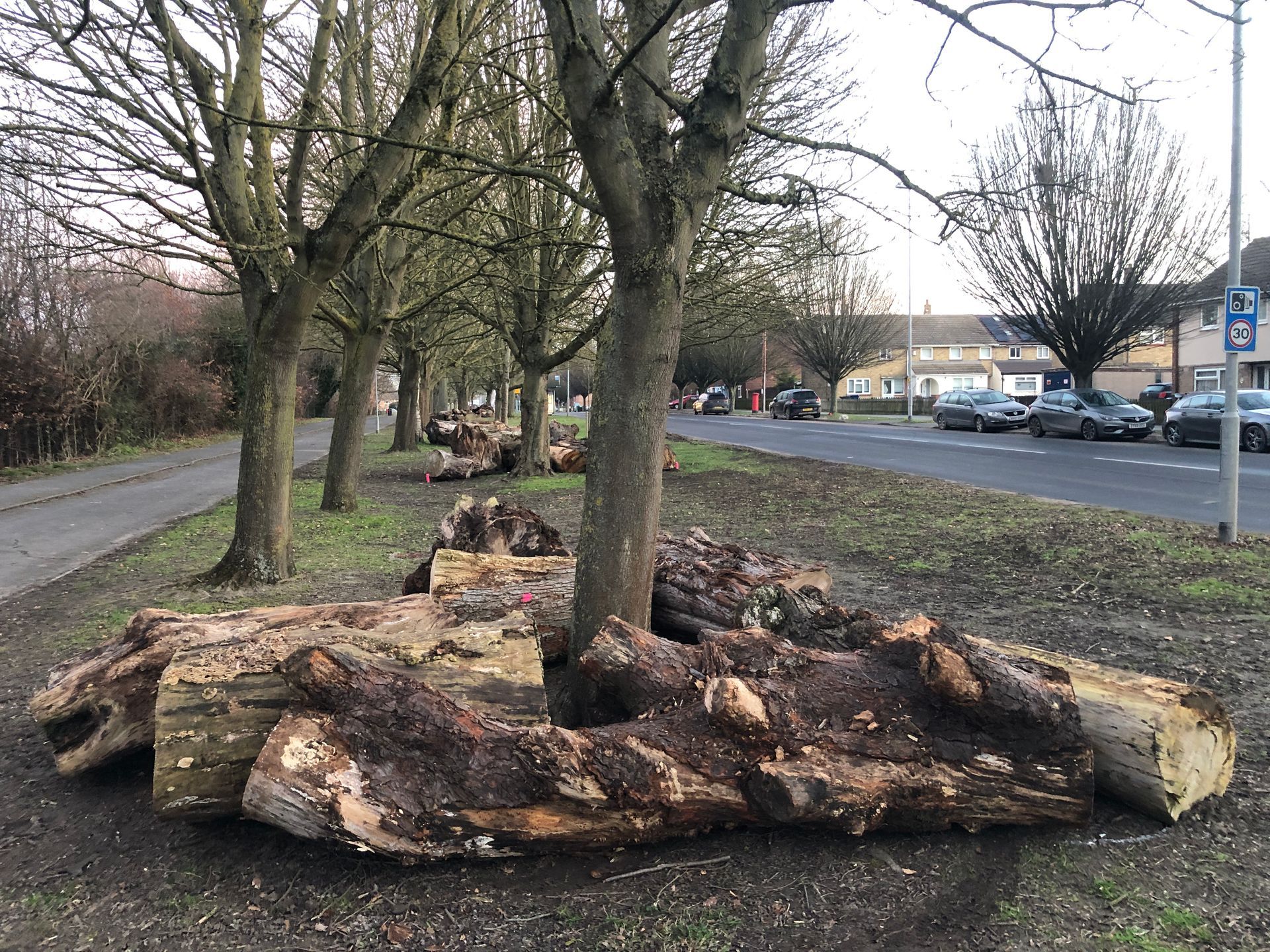
- Fallen trunks and large limbs
- Standing dead trees (monoliths)
- Log walls and log stacks
- Dead hedges
- Habitat piles and stumps
What matters is not neatness or symbolism, but function, scale, and longevity. Ecologically, dead wood occurs in many forms — and the greater the size, age, and continuity of that material, the greater its conservation value.
Dead wood provides niches that do not exist in living trees, including rot holes, loose bark, damp interiors, splits, cavities, and shaded microclimates.
Where Dead Wood Is Used in Practice
In my work, dead wood has been used deliberately across:
- Private domestic gardens
- Public realm projects
- Roadside verges and highway-adjacent land
- Community spaces
- Biodiversity Net Gain (BNG) projects, including work in Ely
Dead wood is not limited by scale or setting — but it must be designed differently depending on context, access, and public interaction.
Case Study: A Log Wall in a Residential Garden, Cottenham
A residential project in Cottenham, near Cambridge, illustrates this clearly.
We needed a physical and visual divide between a pathway and a newly established wildflower meadow. A fence or brick wall would have solved the problem — but would have added nothing ecologically.
Instead, we designed a 60 cm-high wall made entirely of dead logs.
Key decisions:
- A wide mix of native tree species
- Logs of varying diameters and decay stages
- A porous structure with deliberate gaps
What Changed After Installation?
The changes were immediate and cumulative:
- Fungal fruiting bodies appeared as the wood dried and weathered
- Bark loosened and fell away, exposing habitat for dead-wood invertebrates
- The wall created a stable microclimate, allowing us to plant stinging nettle — a vital butterfly food plant — where it had not previously been possible
- The client began actively engaging with the feature, packing straw into cavities to create potential nesting sites for queen bumblebees
Crucially, the dead wood triggered a chain reaction of further habitat creation.
By introducing dead logs to the site, we also introduced beneficial fungal spores, inoculating soil and planting with organisms that were previously absent.
How Quickly Does Dead Wood Start Working?
Dead wood begins functioning immediately, but its ecological value unfolds over time.
As wood decays, it supports a succession of organisms:
- Early colonising fungi and microbes
- Fungi that break down lignin and cellulose
- Saprophytic beetles and insects specialising in different decay stages
- Birds and predators feeding on larvae
Each stage creates habitat for species that cannot survive without dead wood. This process plays out over years, not weeks — which is precisely why continuity matters.
Why I’m Sceptical of “Instant Biodiversity” Claims
Dead wood ecology is often oversimplified.
Not all wood is equal:
- Native species are always preferable
- A range of species and decay stages is far more valuable than volume alone
- “Any pile will do” is incorrect
Some woods are actively poor choices. Walnut, for example, contains antimicrobial compounds and is effectively a dead zone for dead-wood ecology. It should be avoided.
Dead wood does not deliver instant biodiversity. Like meadows, it works through time, succession, and restraint.
When Dead Wood Gets Pushback (and Why)
Ecologically, dead wood rarely fails.
Socially, it often does — when it isn’t explained or designed with people in mind.
On the Needs of Hope Verge Project in Cambridge, we used large trunk wood deliberately, following local authority policy.
Large trunks:
- Cannot be easily moved or removed
- Are less likely to be vandalised or taken as firewood
- Reduce perceived risk
Equally important, the installations were explained. Once people understood what they were seeing, acceptance followed.
Dead wood is still a relatively new aesthetic in public space. Design and education are inseparable.
Safety, Risk, and Long-Term Responsibility
Dead wood generally requires very little maintenance — it is meant to decay.
Standing dead wood does require care:
- Stability must be assessed
- Cement should be avoided
- Foundations should allow natural movement
We use self-binding gravel rather than concrete to reduce shear stress at the base and lower the risk of snapping.
Importantly, evidence from woodland management consistently shows that the dangers of dead and decayed trees are often exaggerated. Where risk exists, reduction, pollarding, or repositioning material is usually preferable to removal.
Retention, wherever safety allows, is the ecologically responsible option.
Scale, Placement, and When Not to Add Dead Wood
Dead wood should never be added as a token gesture.
If a site already contains functioning dead wood habitat, importing more can feel pastiche and unnecessary. Context matters.
Scale matters too:
- A two-metre oak trunk has no place in a tiny garden
- A handful of twigs makes no sense in a large landscape
Placement should always be guided by maximum ecological benefit, not visual symbolism.
Dead Wood Is Habitat First
Dead wood should be treated as infrastructure, not decoration, because it is habitat.
A very large proportion of woodland invertebrate species depend on dead wood at some stage in their life cycle. Many have no alternative habitat. When dead wood is removed, these species are not displaced — they are lost.
Numerically speaking, more fungi, insects, and dependent species rely on dead wood than on living plants. In many contexts, dead wood supports more life than live vegetation.
That is why dead wood matters — not as a visual cue, but as a structural foundation for food webs that cannot be rebuilt quickly, or at all.